
Greenwich County Criminal Court Records
A criminal court record begins when the case reaches the court. It is different from a police report, booking record, or jail roster entry. In Greenwich, local police may create the first arrest paperwork, but the court record is maintained through the Connecticut Judicial Branch after charges are filed. The record can include the docket number, defendant information, court location, charge history, scheduled events, motions, plea information, disposition, and sentence when public.
Connecticut's Superior Court is the statewide trial court. Greenwich criminal and motor-vehicle matters are handled through Stamford-area Superior Court channels, including Stamford Geographical Area 1 and Stamford Judicial District where applicable. The Office of the State's Attorney for the Judicial District of Stamford/Norwalk prosecutes Greenwich criminal matters in that district. Public defender services for eligible defendants are also tied to Stamford/Norwalk J.D. and G.A. #1 at the Stamford courthouse.
The assigned criminal image source is the Connecticut Division of Criminal Justice criminal records guidance.
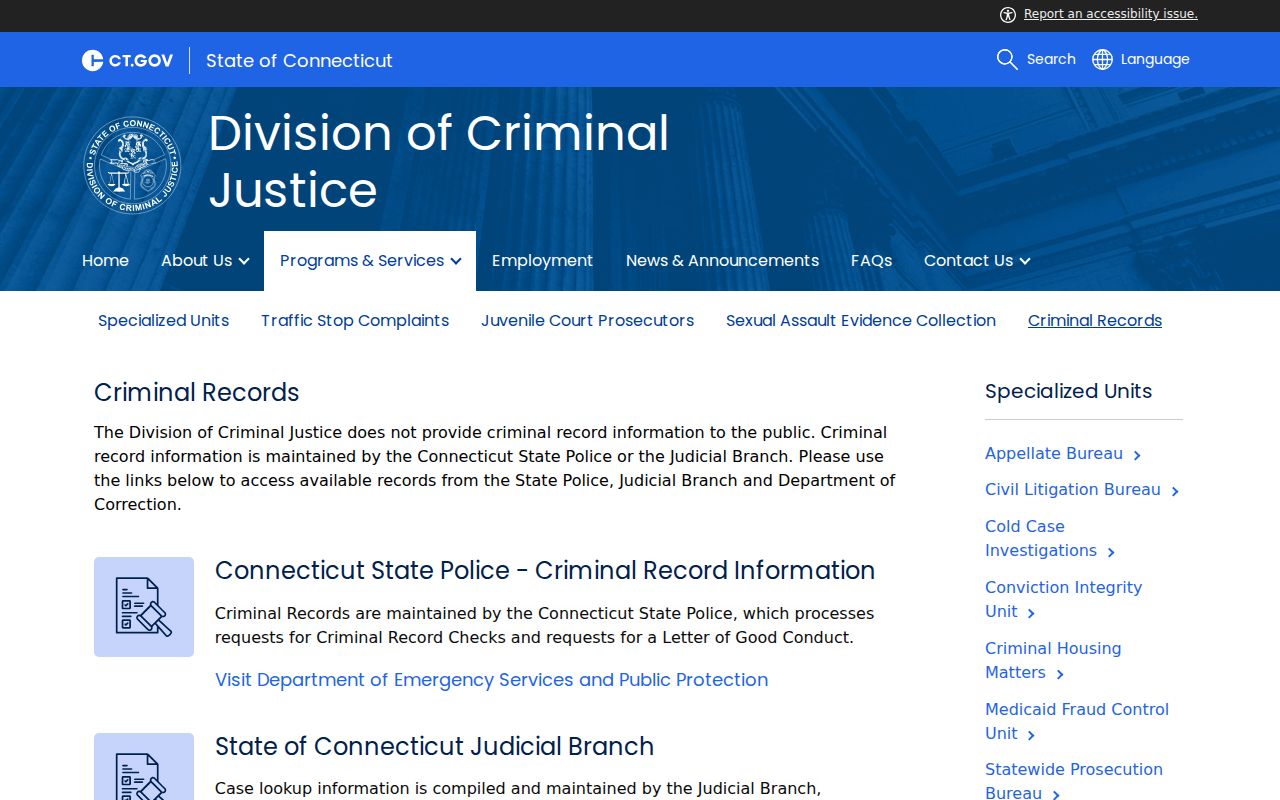
The source reinforces the difference between official criminal justice records and the local police or court channels a Greenwich user may need for a specific case.
Search Greenwich County Criminal Cases
The Judicial Branch criminal/motor-vehicle lookup menu is the main public access point. It links to pending case by defendant, pending case by docket number, convictions by defendant, convictions by docket number, daily docket by court, daily docket by defendant, sentence review docket, motions to seal or close, and arrest warrants. A user searching for an active Greenwich-related criminal case should usually start with pending case by defendant or docket number. A user checking an older outcome may need conviction search.
- Open the Judicial Branch criminal/motor-vehicle lookup menu.
- Choose pending case, conviction, daily docket, or docket-number search based on the question.
- Enter the defendant last name, first initial, birth year, or docket number when available.
- Use Stamford Geographical Area 1 or Stamford Judicial District filters when they match the case location.
- Read the docket, charge status, disposition, and sentence fields, then contact the Superior Court Clerk for certified records.
The conviction-by-defendant search uses last name, first initial, birth year, birth-year range, court location, and case type. It separates criminal and motor-vehicle records. The criminal portal notice says conviction information is generally shown for no more than 10 years after sentencing unless Practice Book section 7-13 provides a shorter display period.
Greenwich County Criminal Case Flow
A Greenwich arrest may lead to formal charges, then an arraignment and later court events in Stamford-area Superior Court. Each stage can add a docket entry or case record field. The case flow is not proof of guilt. It is the court's process for handling the accusation, release conditions, motions, negotiations, trial rights, disposition, and sentence if there is a conviction.
Case flow: Charges Filed › Arraignment › Pretrial and Motions › Plea or Trial › Disposition › Sentencing
| Stage | What Happens |
|---|---|
| Charges Filed | The prosecutor brings formal charges that create or update the criminal court case. |
| Arraignment | The court addresses the charge, appearance, release conditions, and next date. |
| Pretrial and Motions | Parties file requests, negotiate, exchange information, or seek court rulings. |
| Plea or Trial | The case resolves by plea, trial verdict, dismissal, or another disposition. |
| Sentencing | The court imposes the consequence after conviction, such as probation, custody, or other terms. |
For a closer look at the arrest-to-charge path before the full case outcome, use the Greenwich arrest records and court charges page.
Greenwich County Criminal Record Fields
Criminal case records should be read field by field. The defendant name identifies the person charged. The docket number identifies the court case. The court location shows where the case is handled. The charge list shows accusations as filed or amended. The disposition states how a charge or case resolved. A sentence appears only after a conviction or qualifying plea outcome.
| Field | What It Shows |
|---|---|
| Docket Number | The court case identifier used for pending case, conviction, and docket-number searches. |
| Defendant | The person accused in the criminal or motor-vehicle matter. |
| Court Location | The Stamford-area or other Connecticut court location tied to the case. |
| Charges | The filed accusations, which may later be amended, reduced, dismissed, or resolved. |
| Plea or Verdict | The defendant's plea or the outcome reached by the court or fact finder. |
| Disposition | The final result of a charge or case, such as conviction, dismissal, or other resolution. |
| Sentence | The court-imposed consequence after conviction, when public and displayed. |
Greenwich Charges vs Convictions
A charge is an accusation. A conviction is a resolved outcome that establishes guilt through a plea or verdict. Greenwich criminal court records can show charges that never become convictions. Charges may be dismissed, nolled, reduced, amended, or erased under Connecticut law if statutory conditions are met. Reading only the first charge line can give the wrong impression of a case.
| Point | Charge | Conviction |
|---|---|---|
| Meaning | Formal accusation filed in court | Guilt established by plea or verdict |
| Timing | Early or amended stage of the case | After disposition |
| Record Risk | May be pending, dismissed, or changed | May carry sentence and collateral effects |
| Portal Limits | Pending cases may appear in pending search | Convictions are subject to display limits |
Note: A charge line alone should not be read as a conviction or final sentence.
Greenwich County Criminal Dispositions
The disposition is the outcome of a charge or case. It may show a conviction, dismissal, not-guilty result, nolle prosequi, or other court action. Connecticut also uses erasure rules that can change what remains visible in public systems. When a case has several charges, each charge may have a separate status or disposition, so the final record should be read charge by charge.
- Disposition
- The outcome or resolution of a charge or case.
- Sentence
- The court-imposed consequence after conviction.
- Arraignment
- An early court hearing for charges, release conditions, and next steps.
- Bond
- Security or a promise used to secure a defendant's appearance.
Greenwich Sealed vs Erased Records
Connecticut often uses the term erasure where the public might say expungement. Sealing and erasure are not the same. A sealed file is restricted from public inspection by court rule or order. An erased criminal record is treated under Connecticut's erasure statute after a qualifying dismissal, not-guilty finding, pardon, or other statutory event. Juvenile and youthful-offender matters are not shown in the public criminal lookup.
| Point | Sealed | Erased |
|---|---|---|
| Public View | Blocked or limited by court restriction | Removed from public treatment under statute |
| Common Trigger | Confidential law, court order, or protected case type | Qualifying dismissal, acquittal, pardon, or statutory event |
| Search Result | May show little or no detail | May not appear in public criminal lookup |
| Authority | Court rules and case-specific orders | Conn. Gen. Stat. Sec. 54-142a |
Greenwich County Criminal Access Limits
Connecticut FOIA statutes provide the general public-record framework, and Section 1-215 covers records of arrest within specified limits. Court access still depends on Judicial Branch rules, sealing, erasure, juvenile confidentiality, and portal display limits. The public criminal portal says youthful-offender cases, juvenile cases, and infraction and violation convictions are not shown.
For municipal police records, Greenwich Police General Services is the custodian. Police records may be requested online, by printable form, by mail, or by hand delivery, but the police page says open investigations may not be releasable. For the court case file, the Superior Court Clerk is the correct custodian. For state custody after sentencing, Connecticut Department of Correction systems are separate from the court docket.
Important: Criminal case lookup is not a consumer background report and should be verified with the official custodian.
Greenwich County Criminal Court Contacts
Criminal prosecution for Greenwich Superior Court matters is handled by the Office of the State's Attorney for the Judicial District of Stamford/Norwalk. The research records that David R. Applegate was appointed State's Attorney on May 7, 2026, and that the district includes Greenwich. Public defender services for eligible defendants are through Stamford-Norwalk J.D. and G.A. #1.
Stamford-Norwalk J.D. and G.A. #1
123 Hoyt Street
Stamford, CT 06905
J.D. Public Defender 203-965-5245
G.A. Public Defender 203-965-5241
Stamford/Norwalk State's Attorney
Judicial District of Stamford/Norwalk
Prosecutes Greenwich criminal matters in the district